






























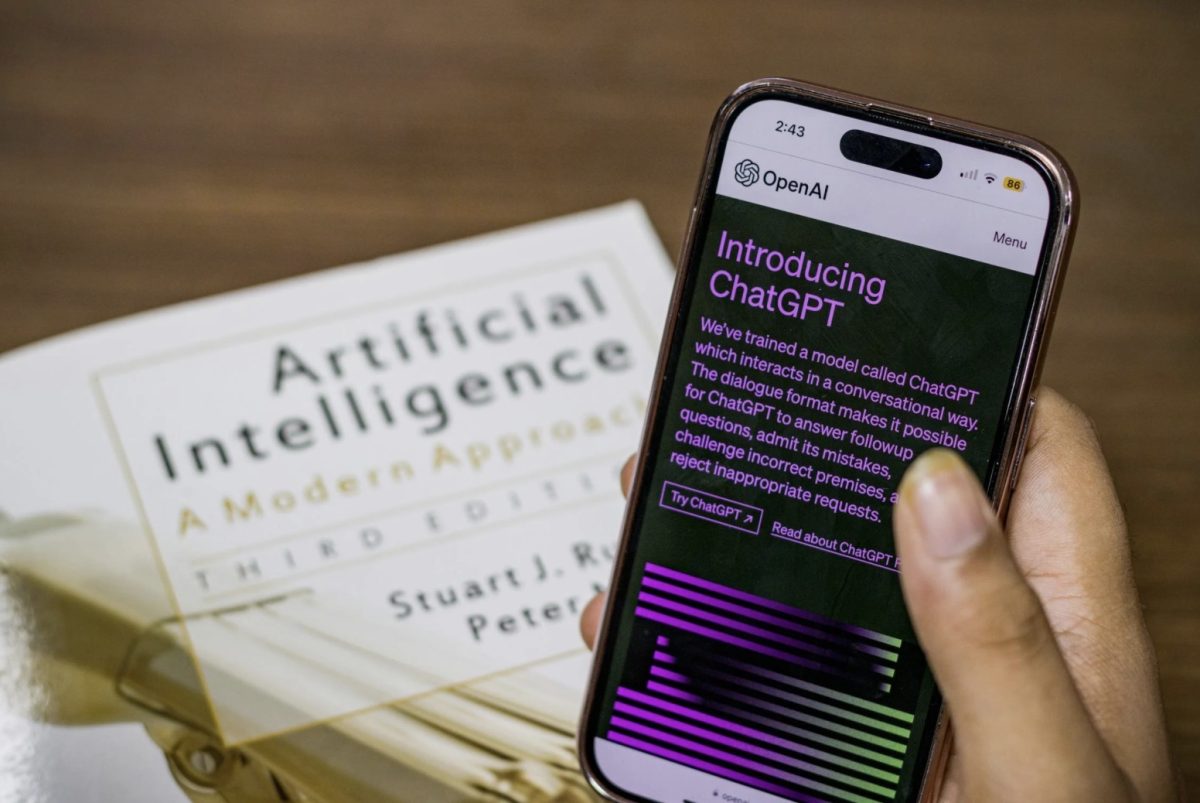
Artificial Intelligence—platforms capable of completing tasks like homework and essays that once required human thinking— has swept the nation, but these conveniences come with a cost.
Even though Artificial Intelligence has now been threaded through all sorts of platforms and is seemingly inescapable, a lot of people still don’t seem to understand how AI works. Artificial intelligence is a general term for a branch of computer science that enables machines to simulate human behavior. According to Mr. Jackson, a computer science teacher at Bishop Gorman, AI platforms like ChatGPT employ a type of generative AI called Large Language Model (LLM). LLM is a type of program trained with large amounts of text. Jackson states that “It analyzes patterns in that data so thoroughly that it can generate new text, images, or code that resemble what it has seen before.” Mr. Jackson explained that these systems use “probability to predict what word, phrase, or action is most likely to come next. It is performing very advanced mathematics to determine the most statistically likely response based on patterns it learned during training.”
These programs are undeniably efficient and easy-to-use. However, the ethics of AI use have come into question amid growing environmental concerns. Mr. Jackson noted that “data centers require significant electricity, large volumes of water, and substantial physical space,” additionally, “data centers can lose up to 80% of the water used through evaporation”.
The ramifications of these programs are alarming, but the media has since called attention to the cause and the youth have started to take action. Environmental Club President Victoria Offley ‘26 stated that AI platforms are “straining our local quantity available which threatens the near future.” Offley claims that her mission as president of the club is to encourage “recycling and the health and future of our Earth.” The senior said that students can cut back on use of these platforms by using “ it as support not replacement for work.” On a corporate level, Mr. Jackson believes that, similarly to the oil industry, “If AI infrastructure were shown to cause measurable environmental damage, companies should likewise be responsible for mitigation and repair.”
Switching to an academic lens, LLM platforms can have detrimental effects on cognitive health. In a small study performed at MIT’s Media Lab, researchers divided participants into three groups to write several SAT essays: the first group used OpenAI’s ChatGPT, the second group used Google’s search engine, and the final group used nothing at all. Using an EEG, researchers concluded that of the three groups, ChatGPT users had the lowest brain engagement and underperformed at “neural, linguistic, and behavioral levels.” Additionally, “ChatGPT users got lazier with each subsequent essay, often resorting to copy-and-paste by the end of the study.” (https://time.com/7295195/ai-chatgpt-google-learning-school/)
These effects have not gone unnoticed, especially at high schools as students become increasingly reliant on ChatGPT to complete assignments. Sanya Jolly ‘26 noted that this overreliance can “make students want to immediately choose the easier option and make them want to plug a question into AI rather than actually trying to work out the issue.” Additionally, Jolly believes that “it adds to our culture of instant gratification and getting an answer quickly.” On the other hand, Mr. Jackson claims that these platforms can have immense benefits for the educational system. Noting “that level of personalization could meaningfully support learning.” On the other side of that same coin, the teacher claims that he is also “seeing students and even educators use AI to shortcut the learning process rather than deepen it,” he continues, “there is an ethical and productive way to integrate AI, but it requires intentional design, clear expectations, and teaching students how these systems actually work.”
Artificial intelligence is a groundbreaking innovation that could easily transform academics and technology as we know it. These tools might seem like a friend, but Mr. Jackson warns that “at the core, it is pattern recognition and probability, not comprehension.”
With rapid technological discoveries, simplifying human tasks has become embedded into modern day society. These tools could be killing the earth and human’s cognitive abilities. Now is the time to take action, use these platforms only when absolutely necessary, and not always take the easy way out.