

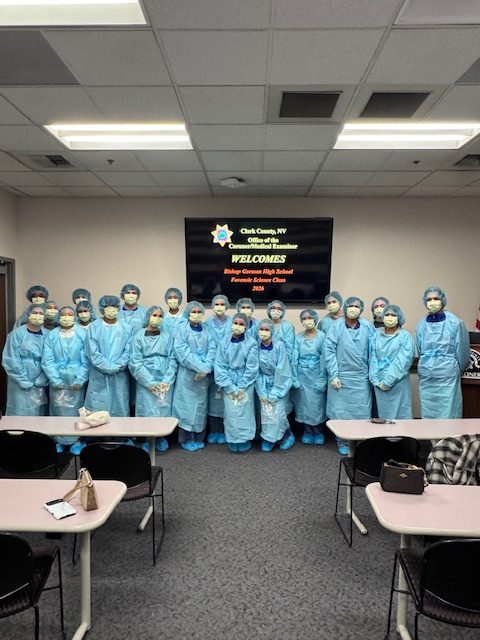





April 17, Honors Forensics II students at Bishop Gorman traded their classroom for a real-world learning experience at the Clark County Coroner’s Office. As part of their anthropology unit, the trip gave students the opportunity to deepen their understanding through hands-on, in-person exposure to forensic science in action.
The visit began with a presentation introducing students to the role and responsibilities of the coroner’s office. Staff members explained how bodies are received, identified, and examined to determine both cause and manner of death. Students learned about the autopsy process and were shown real-life case examples, including fatal car accidents and desert bones found. Some cases were especially difficult to see, as real crime scene photos were shared to illustrate the realities of forensic investigation. “The photos were honestly quite disturbing, but it showed me what really could happen if people are not safe and smart on the roads,” said Skylar Palmeri ‘26.
After the presentation, students suited up in full protective gear–scrubs, gloves, masks, hair nets, and shoe covers—before beginning their tour of the facility. Their first stop was the intake garage, where bodies are brought in and initially processed. Here, staff explained how each individual is weighed and documented, with details such as height, sex, and identifying features recorded. Screen displayed a list of individuals recently brought into the facility, emphasizing the real and ongoing nature of the work done there.
Next, students entered the cooler, where bodies are stored. The cold, sterile environment left a strong impression. On the day of the visit, several bodies lay on covered gurneys, creating a moment that many students described as surreal. “In my mind, I couldn’t process that there were actual bodies on those gurneys. It felt like I was in a TV show,” said London Casey ‘26. She also noted the overwhelming sensory experience: “The smell was something I couldn’t describe. It was very intense, and they even gave us bags in case anyone felt sick.”
The tour continued into the autopsy room, which resembled a large medical lab equipped with sinks, examination tables, and surgical tools. Although no autopsy was being performed at the time, students learned about the procedures conducted there, including how examiners carefully study organs to determine cause of death. For many, this room made the experience feel even more real, reinforcing both the complexity of the human body and the seriousness of the work.
After the tour, students returned to the presentation room to reflect on what they had seen. While the experience was unsettling at times, it also sparked curiosity and respect for the field. “It genuinely was an eye-opening experience,” said Anastazia Levzow ‘26. “It taught me so much, and I understand the human body more and what it takes to be a medical examiner.”
Overall, the field trip gave students a deeper appreciation for forensic science and the vital role of the coroner’s office. By stepping outside the classroom, they gained real-world insight that left a lasting impression.