
















“Free Solo” climber, Alex Honnold, takes on Taiwan’s tallest landmark, testing the limits of courage, risk, and human potential.
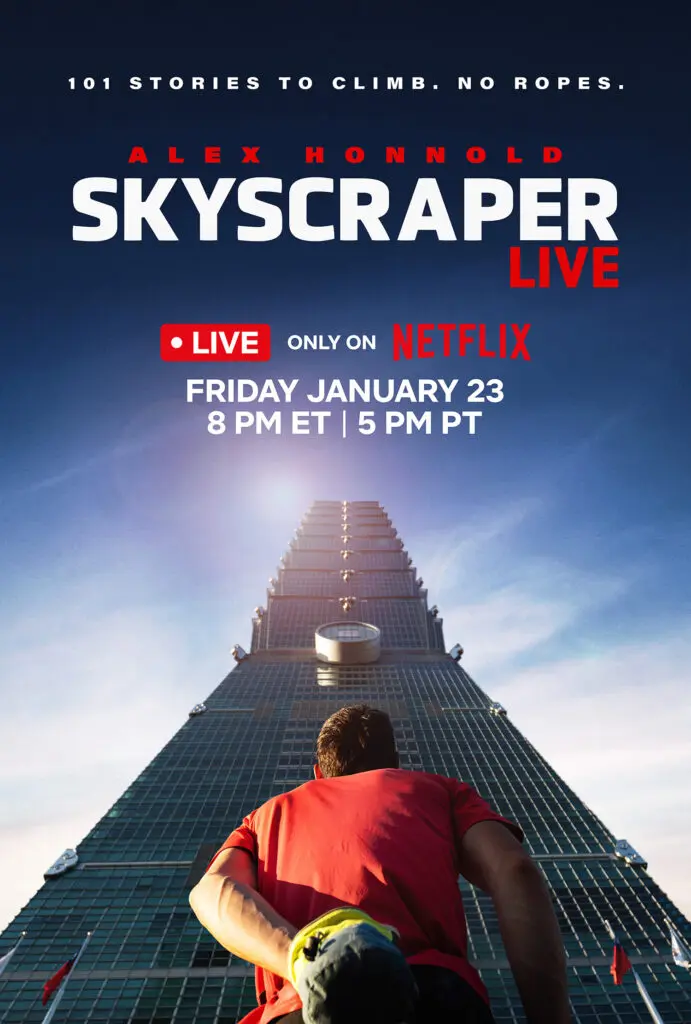
On Jan. 24, Alex Honnold, the world-renowned American rock climber best known for Free Solo–scaled Taiwan’s iconic Taipei 101 in the Xinyi District of Taipei City in one hour and 31 minutes. The daring ascent was livestreamed globally as part of a Netflix produced project examining why extreme, real-life courage continues to push the limits of human potential—and why such feats still captivate audiences around the world.
The climb was carried out with a full technical safety system in place, including secured ropes, professional rigging teams, on-site safety personnel, and even collaboration with building officials. These measures allowed the focus to remain on the physical and mental challenge of climbing a structure never designed for humankind to conquer.
The climb itself was broadcasted live to viewers around the world aiming to explore why extreme achievements still resonate with the modern digital age. Unlike natural rock faces, Taipei 101’s glass-and-steel exterior posed a unique and unforgiving challenge. “It’s way scarier than climbing a mountain because the building isn’t meant for people—it makes it feel unreal,” said Lauren Funai ‘27.
In a world increasingly dominated by screens and curated online experiences, witnessing genuine human courage in real time carries a rare emotional weight for viewers. “Seeing someone risk everything helps me realize what humankind can truly achieve,” said Angelina Rivera ‘27.
Honnold’s climb served as a powerful reminder that pushing boundaries—both physical and psychological—still resonates deeply with people. Rising above the everyday skyline of Taipei, the ascent symbolized how acts of determination and bravery can inspire audiences to push themselves beyond what they think is possible.